Morse

Morse Code Number – Learn How to Encode and Decode Numbers

Morse code isn’t just a series of dots and dashes! It’s a universal language that has helped people communicate across distances for over a century. While most people are familiar with letters in Morse code, numbers play an equally crucial role in transmitting important information, from emergency signals to secret messages.

Understanding how to encode and decode numbers in Morse code can be both practical and fun, whether you’re a hobbyist, a history enthusiast, or someone learning emergency communication skills.

With our Morse Code Translator, you can instantly convert numbers to Morse code and decode them back in seconds, making learning and practice easier than ever.
In this article, we’ll guide you through the Morse code number system, explain its importance, and show how you can use our translator to master numerical encoding and decoding effortlessly.

Learn Morse Code Numbers

What Is Morse Code Number?

Morse code numbers are a set of signals using dots (·) and dashes (–) to represent the digits 0–9. Each number has a unique pattern that makes it easy to send and decode messages accurately. While letters in Morse code focus on the communication of words, numbers allow the precise transmission of critical information like dates, times, coordinates, or emergency codes. Use the main Morse Code Translator tool to verify all number translations.

Difference Between Letters and Numbers in Morse Code

Letters: Use combinations of 1–4 signals per letter (dots and dashes).

Numbers: Always use 5 signals per digit, with a specific pattern: the number of dots or dashes in a sequence indicates the digit. For example, 1 is ·––––, 5 is ·····, and 0 is −−−−−.

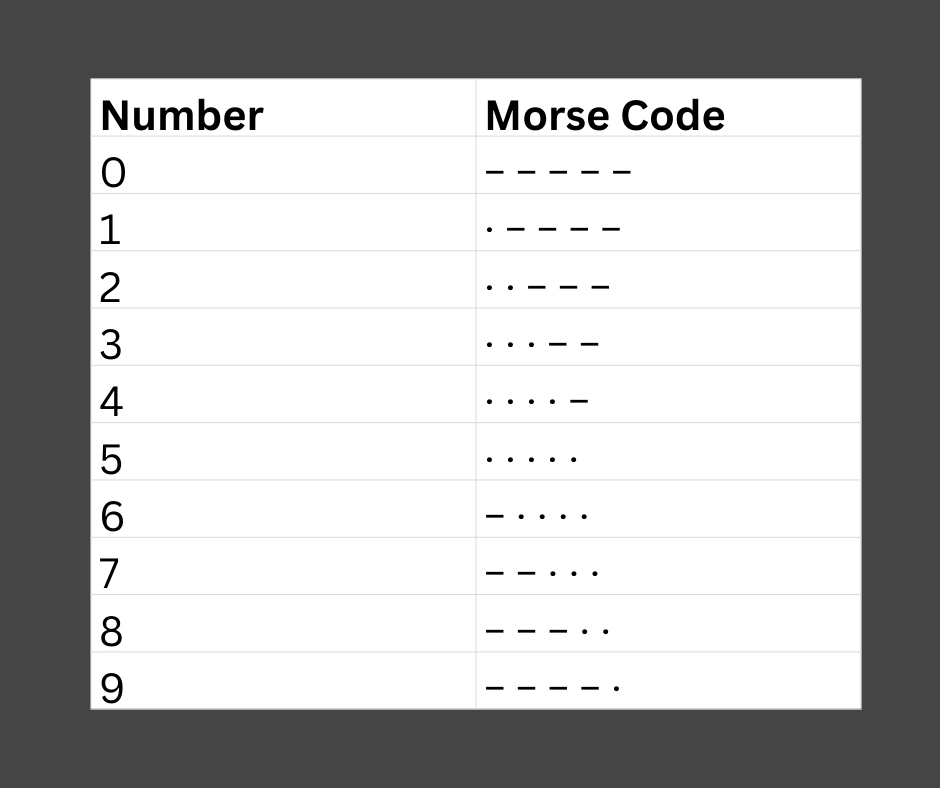
Morse Code Numbers Chart (0–9)

Numbers in Morse code are represented using a combination of dots (·) and dashes (–). Each number follows a unique five-signal pattern, making them easy to distinguish. Here’s the complete chart:

Morse Code Numbers Chart (0–9)

Examples of Encoding Numbers
♦ 123 → · − − − − · · − − − · · · − −
♦ 507 → · · · · · − − − · · ·
♦ 2025 → · · − − − · − − − · · · · −

Visual Representation for Easy Memorization

Visual aids help learners remember Morse code numbers quickly. Imagine each dot as a short beep or flash and each dash as a long one. You can also use mnemonic patterns: for example, the number 1 has one dot followed by four dashes, and the number 5 is five dots in a row, which is symmetrical and easy to recall. The numerical codes are integrated directly into the full Morse Code Alphabets chart.

How to Encode Numbers in Morse Code

Learning to encode numbers in Morse code is like unlocking a secret language used by sailors, pilots, and radio operators for decades. Imagine you’re out at sea or deep in the mountains, and your only way to send a message is through short and long signals! That’s when Morse code numbers come to life.

Step-by-Step Guide to Converting Numbers into Morse Code

  1. Understand the Pattern – Each number in Morse code is made up of five signals (dots and dashes). Numbers start with more dots and fewer dashes as they go from 1 to 5, then reverse the pattern from 6 to 0 with more dashes and fewer dots.
    • For example, 1 = · − − − − and 9 = − − − − ·.
  2. Start Encoding – Break the number into individual digits. Then, replace each digit with its Morse code equivalent.
    • Example: To encode 245, write:
      • 2 = · · − − −
      • 4 = · · · · −
      • 5 = · · · · ·
      • Combined Morse: · · − − − | · · · · − | · · · · ·
  3. Separate Digits Clearly – Use a short pause or space between digits to avoid confusion. Each pause is just as important as the dots and dashes themselves.

Tips for Beginners to Remember Numeric Codes

Learning Morse numbers becomes fast and enjoyable when you use clear patterns, multi-sensory practice, and small daily habits. Below are practical, detailed tips you can apply right away — plus exercises and ways to use the Morse Code Translator to speed up progress. Understanding the difference between number codes and Morse Code Letters is essential for clarity.

1. Understand the Dot and Dash Pattern

Numbers follow a predictable pattern: 1–5 build up dots, 6–0 build up dashes. Use that rule as your mental anchor.

  • Visual rule
    • 1 = dot + four dashes (· − − − −)
    • 2 = two dots + three dashes (· · − − −)
    • 3 = three dots + two dashes (· · · − −)
    • 4 = four dots + one dash (· · · · −)
    • 5 = five dots (· · · · ·)
    • 6 = dash + four dots (− · · · ·)
    • 7 = two dashes + three dots (− − · · ·)
    • 8 = three dashes + two dots (− − − · ·)
    • 9 = four dashes + one dot (− − − − ·)
    • 0 = five dashes (− − − − −)
  • Memory trick

Treat 1–5 as “adding dots” from left to right. Treat 6–0 as “adding dashes” from left to right. This reduces the task to remembering two short rules instead of ten separate patterns.

2. Use Visual and Memory Tricks

Mnemonics make abstract patterns sticky.

  • Example images

    • 1: imagine a single lighthouse flash followed by a long foghorn (one short, four longs).

    • 5: imagine five quick camera clicks in a row.

    • 0: picture five long train whistles.

  • Make it personal

Attach each number to a familiar object or action (1 = one sunbeam, 2 = two door knocks, 7 = two large waves then three small ripples). Personal, silly images are easier to recall.

3. Practice by Listening, Not Just Reading

Morse is first and foremost an auditory language. The rhythm tells you the symbol.

  • Listening drills
    • Use your translator to play or generate audio for single digits. Close your eyes and identify the number by sound.
    • Start with pairs (1 and 5, 2 and 4) to learn contrasts: how a short-long rhythm differs from a long-short rhythm.
    • Gradually increase speed once you can recognize digits at a slow pace.
  • Rhythm focus
    • Count time units: dot = 1 unit, dash = 3 units, short gap between symbols = 1 unit, gap between digits = 3 units. Practicing timing trains accurate decoding.

4. Combine Visual, Auditory, and Touch Learning

Combining senses cements memory faster than any single method.

  • Visual: flash the pattern on a screen or draw dots and dashes on paper.
  • Auditory: play the pattern as beeps or short/long tones.
  • Kinesthetic: tap dots and dashes with your fingers or on a desk: short tap for dot, long press for dash.

5. Practice in Short, Consistent Sessions

Practice in small daily bursts for consistent improvement.

  • Micro sessions: 5–10 minutes, twice daily.

  • Focus sessions: one session for encoding (writing numbers to Morse) and one for decoding (listening and translating).
  • Progression: Day 1 practice 1–3; Day 2 add 4–6; Day 3 review 1–6 and add 7–9 and 0.

6. Use Flashcards or Spaced Repetition

SRS (spaced repetition systems) help move patterns into long-term memory.

  • Flashcards: front has the number, back has the Morse pattern and an audio clip.
  • Scheduling: review new digits more frequently (daily), then space to every few days, then weekly as you master them.
  • Use a simple app or paper index cards if you prefer offline.

7. Practice with Real-World Examples

Apply Morse numbers to fun, realistic tasks to keep motivation high.

  • Real-world drills: encode your postcode, phone number, or current time and decode them back.
  • Games: time yourself decoding five random digits; aim to improve speed without sacrificing accuracy.
  • Pair exercises: have a friend call out numbers while you tap or decode, or swap roles and test each other.

8. Break Long Numbers into Small Chunks

When encoding or decoding long numbers, treat each digit as its own five-signal unit.

  • Example: 274 → decode 2, then 7, then 4, rather than trying to parse the whole sequence at once.
  • Pause clearly between digits; practice adding the correct gap so digits don’t run together.

9. Track Progress and Fix Mistakes

Keep a simple log and refine your approach.

  • Keep a practice journal: date, what you practiced (digits), accuracy, and speed.
  • If you frequently mix up certain digits, isolate them and create targeted mnemonics or extra listening drills.
  • Slow down if accuracy drops at higher speed! Speed is useful only when recognition is reliable.

10. Level Up with Advanced Practice

    • Practice with background noise to simulate real-life radio conditions.
    • Work on increasing speed in 10% increments while preserving accuracy.
    • Learn common numeric sequences you’ll use often (e.g., emergency codes, coordinates formats) so you can decode them as chunks rather than single digits.

11. Use Our Morse Code Translator as Your Practice Partner

Our Morse Code Translator is the fastest and easiest way to learn and master Morse numbers. Whether you’re just starting out or perfecting your speed, it helps you encode, decode, and listen to patterns instantly! All in one place.

  • Auto-generate Practice Sets: Use our translator to create random number sequences. Try decoding them yourself to test accuracy and build confidence.
  • Get Instant Feedback: Type any number into our translator to see its Morse code version in real time. Then, decode it back to check your understanding! A perfect way to self-correct while learning.
  • Improve Listening Skills: Use the audio playback option in our Morse Code Translator to hear how numbers sound in real Morse rhythm. Practice at different speeds to sharpen your ear and timing. Once you know the numbers, you can begin forming complex Morse Code Words that include quantities.

How to Decode Morse Code Numbers

Decoding Morse code numbers is like solving a rhythmic puzzle! Each sequence of dots and dashes hides a number waiting to be revealed. Once you learn to recognize patterns, you’ll be able to read Morse numbers effortlessly by sight, sound, or signal.

Step-by-Step Guide to Reading Morse Code Numbers

  1. Identify the Length of the Signal:
    Every number in Morse code is made up of five signals! A mix of dots (·) and dashes (−). Start by counting the signals to confirm you’re reading a number, not a letter.
  2. Recognize the Pattern:
    • Numbers 1–5 begin with dots and end with dashes.
    • Numbers 6–0 begin with dashes and end with dots.
      Example:
    • 2 = · · − − −
    • 8 = − − − · ·
  3. Decode Digit by Digit:
    Separate each set of five signals and decode one number at a time. This helps prevent mixing up digits when decoding long numeric sequences.
  4. Recheck with a Translator:
    After decoding manually, use our Morse Code Translator to verify your results instantly. This reinforces accuracy and helps you learn from any mistakes.

Techniques to Quickly Recognize Patterns

Visual Pattern Recognition:
Train your eyes to notice how dots and dashes shift gradually — numbers near 5 have more dots, while those near 0 have more dashes.

Rhythm Training:
Listen to Morse beeps using the translator. The rhythm of short and long sounds helps you identify digits faster than reading symbols alone.

Grouping Practice:
Practice decoding sets of three or four numbers at once. This improves focus and prepares you for real-world communication or radio decoding.

Tools and Apps to Decode Numbers

Our Morse Code Translator:
The easiest way to decode numbers automatically. Just paste or type Morse symbols, and the translator will instantly display the numbers.

Audio Playback Mode:
If you’re practicing listening skills, use the audio option to play Morse beeps and identify digits by sound.

Mobile Practice Apps:
Pair our Morse Code Translator with mobile Morse code training apps to practice decoding anytime, anywhere.

Common Mistakes with Morse Code Numbers

Learning Morse code numbers can be exciting, but beginners often make small mistakes that lead to major decoding errors. Understanding these common issues and how to avoid them will make your learning process smoother and more accurate. The patterns shown here are consistent with the global rules of International Morse Code.

1. Confusing Numbers with Letters

One of the most frequent mistakes is mixing numbers with similar-looking letters in Morse code.
For example:

  • 1 (· − − − −) can be mistaken for the letter A (· −) or I (· ·) when signals are sent too fast or too short.
  • 5 (· · · · ·) looks similar to the letter H (· · · ·) if the timing isn’t clear.
  • 6 (− · · · ·) might sound like the letter B (− · · ·) if the extra dot isn’t transmitted correctly.

How to Fix It:

  • Always count five signals for numbers — letters never exceed four.
  • Leave a slight pause between numbers and letters to separate them clearly.
  • Use our Morse Code Translator to double-check your sequences and verify if what you’ve entered reads as a number or letter.

2. Timing Mistakes in Signals

Timing is the heartbeat of Morse code. A single delay or rush can change a number’s meaning entirely.
Each signal follows a strict rhythm:

  • Dot (·) = 1 time unit
  • Dash (−) = 3 time units
  • Space between dots/dashes of the same digit = 1 unit
  • Space between digits = 3 units

Example:
If you don’t pause long enough between two digits, · − − − − · · − − − (which should be “12”) could be misread as one continuous, incorrect sequence.

How to Fix It:

  • Use a metronome-like rhythm when practicing.
  • Count silently: “dot-one, dash-three” to stay consistent.
  • Use the audio playback in our Morse Code Translator to hear the correct rhythm and match your timing.

3. Ignoring Signal Spacing

Spacing is just as important as the signals themselves. Without proper spacing, even experienced learners struggle to distinguish numbers.
For instance, “123” and “12 3” can look almost identical on paper but sound very different when sent correctly.

How to Fix It:

  • Always use a short pause between each number.
  • Visually separate digits with a space or slash when writing (e.g., · − − − − / · · − − − / · · · − −).
  • Practice decoding random sequences using our translator to strengthen pattern recognition.

4. Lack of Consistent Practice

Another mistake is inconsistent learning. Morse code requires rhythm, speed, and familiarity — skills that fade quickly without repetition.

How to Fix It:

  • Dedicate 5–10 minutes daily for practice instead of long, irregular sessions.
  • Review both encoding and decoding exercises.
  • Use our Morse Code Translator daily to test new numbers and check accuracy instantly.

5. Not Listening Enough

Many beginners focus only on writing or reading Morse code but skip auditory training. However, Morse code is primarily an auditory language! Designed to be heard, not just seen.

How to Fix It:

  • Use our Morse Code Translator’s audio feature to listen to real Morse tones.
  • Practice identifying numbers by sound without looking at the symbols.
  • Gradually increase playback speed as you improve your recognition skills.

Best Practices to Avoid Errors

  • Master one skill at a time: Start with visual recognition, then move to listening and tapping.
  • Stick to the five-signal rule: Every number has five parts! Always count before decoding.
  • Use proper spacing and timing: Precision is more important than speed in early learning.
  • Verify with a translator: Always cross-check your results using our Morse Code Translator to ensure accuracy.
  • Practice daily: Small, regular sessions build lasting skill faster than long breaks.

Applications of Morse Code Numbers

Morse code numbers have many practical uses in different fields, from emergency signaling to modern digital communication. Below are some of the main applications with real-life examples:

1. Emergency Signaling and SOS

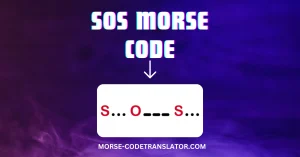
In emergencies, Morse code is one of the simplest and most dependable ways to send distress signals. The SOS code (…—…) is recognized worldwide and can be transmitted through light, sound, or radio signals.
For example, a stranded person can flash a torch or tap on a surface to send SOS when voice communication is not possible. Sailors and rescuers often rely on this pattern during sea emergencies.

2. Military and Aviation Communication

Before modern radio systems, Morse code was commonly used by the military and aviation departments for communication. Numbers helped in identifying aircraft, units, and coordinates precisely.
Even today, pilots and aviation trainees learn basic Morse code to recognize signals from navigation aids like Non-Directional Beacons (NDBs), which identify stations using short Morse sequences that include numbers and letters.

3. Amateur Radio and Hobbyist Usage

Ham radio operators still use Morse code for communication and signal reporting. Numeric codes are used to exchange information such as signal strength or quality.
For instance, radio operators often send “599” in Morse code to indicate a perfect signal report during a contact exchange, also known as a QSO.

4. Modern Applications in Digital and Encrypted Communication

Morse code continues to inspire modern digital and secure communication methods. Some developers use Morse numbers in encrypted messaging systems or password entry tools.
In addition, assistive technology designed for people with speech or movement challenges allows users to type numbers and letters by pressing a single button rhythmically, following Morse patterns.

Frequently Asked Questions

What is a Morse code number?

Morse code numbers are patterns of dots and dashes used to represent digits from 0 to 9.

How do I write numbers in Morse code?

Each number has a unique five-symbol pattern. For example, 1 is .—- and 0 is —– .

Can I use Morse code numbers in emergencies?

Yes, Morse code numbers can help send coordinates or SOS signals when other communication fails.

Is Morse code still relevant today?

Yes, it’s still used in aviation, amateur radio, and emergency signaling.

How do I decode a Morse code number quickly?

Practice regularly or use our Morse Code Translator to decode numbers instantly.

Related Blogs