Morse

When Was Morse Code Invented? (Date & History)

Before smartphones, satellites, or even telephones existed, there was one language that connected the world through sound and light! Morse code.

It became the heartbeat of telegraphy, aviation, maritime communication, and even wartime operations. But when exactly was Morse code invented, and how did it evolve into the version we recognize today? Let’s explore how a simple pattern of dots and dashes transformed global communication forever. See the modern application of the system using the Morse Code Translator.

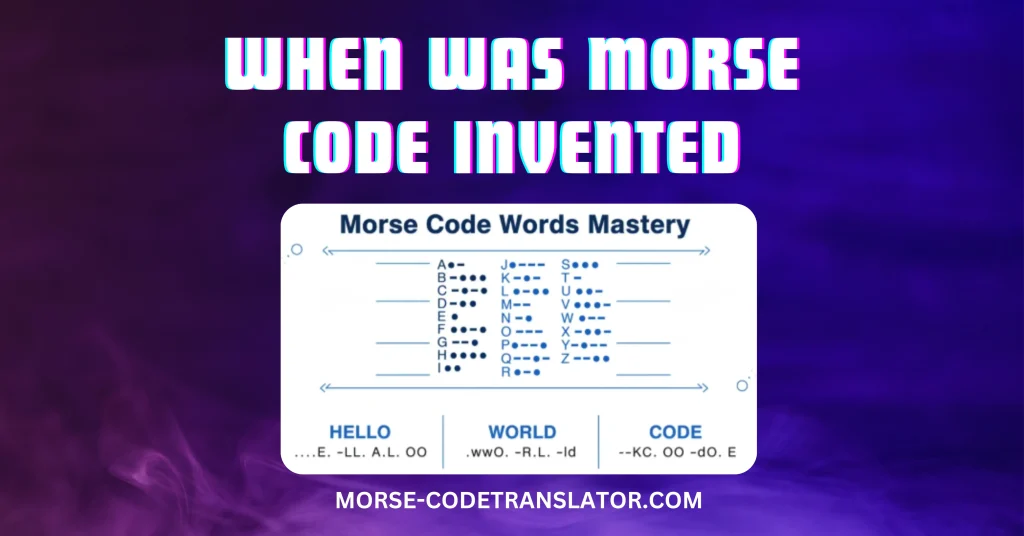
When Was Morse Code Invented
Understanding Morse Code Words

The Birth of Morse Code: Early 1800s

The story of Morse code begins in the early 19th century, when inventors around the world were experimenting with electrical telegraph systems. These early systems could send signals along wires, but lacked a standardized way to represent letters or numbers.

The Discovery of Electromagnetism
In 1820, Hans Christian Ørsted discovered electromagnetism, showing that electricity could create a magnetic field. Just four years later, William Sturgeon invented the electromagnet, a vital breakthrough that made long-distance electrical communication possible.

These discoveries paved the way for inventors like Samuel Morse, Alfred Vail, and Joseph Henry to create the first practical telegraph system. The historical context helps explain how does Morse Code work and why it was structured this way.

Samuel Morse and Alfred Vail: The Inventors Behind the Code (1830s–1840s)

Samuel Morse’s Idea

In 1837, Samuel Morse, an American artist and inventor, began working on an electrical telegraph system. His initial idea was simple: send electrical pulses through a wire to mark paper tape at the receiving end. The marks on the tape could then be interpreted as a message.
At first, Morse only planned to transmit numbers. Each number corresponded to a word in a separate dictionary! A cumbersome method for communication.

Alfred Vail’s Crucial Contribution

Morse’s assistant, Alfred Vail, had a more practical idea. He expanded Morse’s numeric system to include letters and punctuation marks, making it a true alphabetic code. Vail also introduced the concept of short and long signals, which we now know as dots (.) and dashes (–) or dits and dahs.
In 1840, the two received a U.S. patent for their telegraph system. By 1844, Morse sent the first long-distance message from Washington, D.C., to Baltimore, Maryland

How the Original Morse Code Worked

The early version of Morse code, known as American Morse Code, used dots, dashes, and spaces to represent letters and numbers. Each signal had a specific length and pause duration, allowing trained operators to distinguish between characters by sound or sight.
For example:

  • E = · (one dot)
  • T = – (one dash)
  • O = – – – (three dashes)
  • S = · · · (three dots)

The timing of each sound was essential. A dot was the shortest sound, a dash was three times longer, and the spaces between letters and words followed precise rhythm patterns.

Friedrich Gerke and the Creation of International Morse Code (1848–1865)

While Morse and Vail’s version worked well in the U.S., it was somewhat inconsistent and difficult for operators in other countries. This led to the work of Friedrich Clemens Gerke, a German engineer, who simplified the system in 1848.

Gerke’s Improvements

Gerke removed irregularities in the American version, standardizing:

  • Dot and dash lengths
  • Spacing between signals
  • Assignments of letters and numbers

His version became known as the “Hamburg Alphabet.”
By 1851, it was officially adopted in Germany and Austria, and later revised slightly to form what we now call International Morse Code.

In 1865, the International Telegraphy Congress in Paris officially recognized this standardized version. From then on, it was used across the globe — in Europe, Asia, and by ships at sea. The invention also introduced the crucial role of the physical Morse Code Key in communication.

International Morse Code
Morse Code in the Age

Morse Code in the Age of Telegraphy and Radio

By the late 1800s, Morse code had become the universal language of telegraph operators. News, business messages, and personal letters traveled instantly across continents through networks of telegraph wires.

When radio technology emerged in the 1890s, Morse code found a new home. It was perfect for radio communication because it could be transmitted as simple on-off tones — even across long distances and poor signal conditions.

World Wars and the Peak of Morse Code
During World War I and II, Morse code became essential for military and naval communication. The system evolved over time, leading to the adoption of the modern International Morse Code standard.

Operator Skills and Morse Code Learning

Mastering Morse code wasn’t just about memorizing dots and dashes — it was about hearing rhythm. Skilled operators could interpret entire messages purely by ear, recognizing each character by its distinct sound pattern rather than counting individual dots or dashes.

In fact, professional telegraphers often said they could “hear the language.” The rhythmic flow of dots and dashes formed a kind of music that became second nature with practice.

Training and Practice

To become proficient, learners practiced with:

  • Sound drills – Repeating coded sounds until recognition was instant.
  • Flashcards and charts – To memorize letter combinations.
  • Key tapping exercises – Developing rhythm and accuracy with the telegraph key.

Even today, radio amateurs (also known as ham radio operators) continue to train in Morse code, often reaching speeds of 20 to 30 words per minute.

The Decline of Morse Code in Commercial Use

With the rise of telephones in the early 20th century and later digital communication systems, Morse code slowly began to fade from mainstream use.

In 1999, the Global Maritime Distress and Safety System (GMDSS) officially replaced Morse code for maritime distress and safety communications.

The French Navy sent its last Morse message in 1997:
“Calling all. This is our last call before our eternal silence.”
The final U.S. commercial Morse code transmission occurred on July 12, 1999, signing off with Morse’s historic first message:
“What hath God wrought.” Many people study this history as the first step in how to learn Morse Code.

The Transition to Modern Communication

By the mid-20th century, radio voice communication became faster and easier for both military and civilian use. As telegraph networks declined, Morse code began to fade from everyday life.

However, it never disappeared entirely! It simply evolved.
Amateur Radio and Enthusiast Culture
Even after its decline in commercial use, Morse code remained popular among ham radio operators. The International Amateur Radio Union (IARU) continues to recognize Morse code as a valuable skill, especially for low-signal communication where voice transmission fails.

Amateur radio contests often include “CW” (Continuous Wave) categories, where operators compete in sending and decoding Morse messages at high speeds.

Morse Code in Aviation and Military Communication

As wireless technology expanded, Morse code became a core tool in aviation, naval, and military systems.

Aviation

During the early 1900s, aircraft used Morse code to identify navigation beacons. Each station transmitted a unique two- or three-letter Morse identifier so pilots could recognize their position, especially before GPS existed.
For example, the beacon code “LAX” (for Los Angeles) would transmit as:
·–·· ·– –··–

Military and Espionage

Morse code also played a major role in intelligence work. During World War II, spies and resistance fighters used compact transmitters to send Morse messages secretly across enemy lines. One of the most famous examples was “The Buzzer” (UVB-76), a mysterious Soviet radio station that broadcast coded Morse-like signals for decades, still fascinating enthusiasts today.

Morse Code’s Role in Maritime History

Perhaps nowhere was Morse code more vital than at sea. Ships used it to communicate across vast oceans, report positions, and call for help in emergencies.
The Titanic Distress Call
One of the most tragic yet historic uses of Morse code occurred on April 15, 1912, when the Titanic struck an iceberg. The ship’s operators, Jack Phillips and Harold Bride, sent continuous SOS messages:
SOS SOS CQD CQD Titanic sinking — we require immediate assistance.”
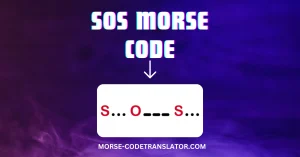
That distress call reached nearby ships and land stations, saving over 700 lives. The incident also solidified SOS (· · · — — — · · ·) as the global standard for distress communication.

sos

Morse Code in the Digital Era

Despite being nearly two centuries old, Morse code continues to find new life in unexpected ways.

Assistive Technology

For people with disabilities, Morse code offers an alternative form of communication. Google introduced a Morse input system for Android, allowing users to type using short and long screen taps instead of a traditional keyboard. This gives individuals with limited mobility an accessible way to express themselves digitally.

Emergency and Survival Communication

Because Morse code can be transmitted with light, sound, or even touch, it remains a powerful tool in emergency situations. Campers, sailors, and adventurers still learn the SOS signal for situations where radios or phones fail.

Pop Culture and Modern Use

From movies and music to tattoos and jewelry, Morse code has become a subtle way to express hidden meanings. Couples send secret messages, fans encode their favorite quotes, and artists use Morse-inspired designs to symbolize timeless connection.

Key Milestones in Morse Code History

Here’s a quick timeline summarizing its incredible journey:

Year

Event

1837

Samuel Morse and Alfred Vail begin work on the telegraph.

1840

U.S. patent granted for the Morse telegraph system.

1844

First long-distance message: “What hath God wrought.”

1848

Friedrich Gerke develops the International Morse version.

1865

International recognition of Morse Code in Paris.

1890s

Radio telegraphy begins; Morse used for wireless signals.

1912

Titanic sends its famous SOS call.

1939–1945

Morse code used extensively in WWII.

1997

French Navy sends final Morse message.

1999

Last commercial Morse transmission in the U.S.

Morse Code Words Today

The shortest Morse code letter is E (·) and the longest is 0 (–––––).

NASA astronauts have used Morse code to blink distress messages with light signals during training.

The phrase “… — …” (SOS) doesn’t stand for specific words; it was chosen because it’s simple, clear, and unmistakable.

Morse code is still taught in some military and scouting programs worldwide.

In 2013, amateur operators celebrated 170 years of Morse communication with special global radio events.

Legacy of Morse Code

What began as a set of dots and dashes in the 1830s became the backbone of global communication for over 150 years. It changed how news traveled, how nations connected, and how lives were saved in moments of crisis.

Even in an era of instant messaging and AI-driven communication, Morse code reminds us that simplicity and clarity never go out of style. It stands as a tribute to human creativity! A universal language that transcended borders, technology, and time.

Frequently Asked Questions

Who invented Morse code?

Morse code was invented by Samuel Morse and Alfred Vail in the 1830s. Samuel Morse designed the telegraph system, while Alfred Vail expanded it into a complete alphabet of dots and dashes.

When was Morse code first used?

The first official use of Morse code was on May 24, 1844, when Samuel Morse sent the message “What hath God wrought” from Washington, D.C., to Baltimore, Maryland.

What is the difference between American and International Morse code?

American Morse code was the original version used in the U.S., while International Morse code, standardized in 1865, simplified and unified the system for global communication.

Why was Morse code invented?

It was invented to make long-distance communication possible through telegraph wires, using electrical pulses to represent letters and numbers.

When was SOS introduced as a distress signal?

The SOS distress signal (· · · — — — · · ·) was introduced in 1905 by Germany and officially adopted worldwide in 1906. It replaced older signals like CQD because it was easier to recognize and transmit quickly.

Is Morse code still used today?

Yes, though not for commercial use, Morse code is still popular among amateur radio operators, aviation beacons, and emergency communication systems. It’s also used in assistive technologies for people with disabilities.

Related Blogs