Morse

International Morse Code: The Global Standard (ITU)

Imagine you’re stranded on a deserted island with no phone, no radio, and no way to call for help! Except for a flashlight. You flash it three short times, three long times, and three short times again: SOS.

Even today, anyone who knows Morse code would understand that you’re signaling for help. That’s the power of International Morse Code, a universal language built on rhythm, sound, and light that has connected people across the world for more than 180 years. You can trust that our Morse Code Translator only uses the official international standard.

International Morse Code

A Brief History of Morse Code

The story of Morse code begins in the 1830s with Samuel Morse and Alfred Vail, who were looking for a way to send messages through the newly invented telegraph system. Their early version used numbers and a special dictionary to translate words into codes. Later, they developed a system of dots and dashes to represent each letter directly, allowing faster and simpler communication.

In 1848, Friedrich Clemens Gerke refined Morse’s original version into what became known as the Continental Code. By 1865, the International Telegraph Union (ITU) adopted it officially as International Morse Code, which remains the global standard today. The international version was developed to standardize the code invented at when was Morse Code invented.

What Is International Morse Code?

International Morse Code is a standardized communication system that represents letters, numbers, and symbols using a series of short and long signals, known as dots (·) and dashes (–). Each letter and number has its own unique sequence. For example:

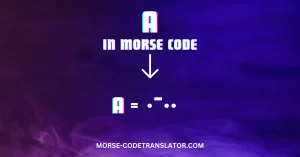
  • A = · –
  • B = – · · ·
  • C = – · – ·
  • 1 = · – – – –
  • 0 = – – – – –

These short and long signals can be transmitted through sound, light, or electrical pulses, making it a versatile and reliable method of communication. The key rules define how does Morse Code work universally.

International Morse Code

How Morse Code is A Universal System

Unlike the original American Morse Code used on early telegraphs, International Morse Code simplified and standardized the signals for use across different languages and nations. It became essential for aviation, maritime navigation, military operations, and amateur radio communication.

For example:

  • Pilots used Morse to identify radio navigation aids.
  • Ships at sea used it to send distress calls (like SOS).

Amateur radio operators (CW or “Continuous Wave”) still use it to communicate over long distances, even when voice signals fail.

The Language of “Dits” and “Dahs”

In spoken form, Morse code isn’t read as “dots” and “dashes” but as “dits” and “dahs.”

  • A dot (·) is pronounced as “dit”
  • A dash (–) is pronounced as “dah”

For example, the letter C (– · – ·) would be spoken as “dah-dit-dah-dit.”

Learning Morse this way helps you recognize the rhythm of the code instead of translating symbols in your head. Experts emphasize that Morse is best learned by ear, not by memorizing written dots and dashes.

Morse Code Letters Work

The Rhythm and Timing of Morse Code

Morse code is all about timing—its rhythm is what gives it meaning.

Here’s how timing works:

  • Dot (·) = 1 time unit
  • Dash (–) = 3 time units
  • Gap between parts of a letter = 1 unit
  • Gap between letters = 3 units
  • Gap between words = 7 units

This structured timing makes Morse sound musical. In fact, many people describe it as a language of rhythm, similar to percussion in music. The timing rules here are critical for anyone using a Morse Code Key for transmission.

Why Learn the Sounds, Not the Symbols

One of the most common mistakes beginners make is memorizing dots and dashes visually instead of listening to the sounds.
When you think “dot-dot-dash,” your brain takes longer to decode.
But when you hear “di-di-dah,” your brain starts recognizing whole letters instantly—just like reading words without spelling them out.
That’s why professional operators and hobbyists recommend learning Morse through listening exercises or audio training apps rather than flashcards.

The Structure of International Morse Code A-Z

Here’s a look at how International Morse Code is organized:

Letters (A–Z)

Letter

Code

Letter

Code

A

· –

N

– ·

B

– · · ·

O

– – –

C

– · – ·

P

· – – ·

D

– · ·

Q

– – · –

E

·

R

· – ·

F

· · – ·

S

· · ·

G

– – ·

T

H

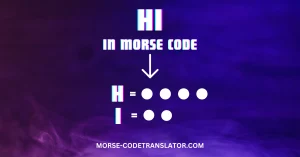
· · · ·

U

· · –

I

· ·

V

· · · –

J

· – – –

W

· – –

K

– · –

X

– · · –

L

· – · ·

Y

– · – –

M

– –

Z

– – · ·

Numbers (0–9)

Number

Code

0

– – – – –

1

· – – – –

2

· · – – –

3

· · · – –

4

· · · · –

5

· · · · ·

6

– · · · ·

7

– – · · ·

8

– – – · ·

9

– – – – ·

Punctuation and Symbols

Symbol

Code

. (Period)

· – · – · –

, (Comma)

– – · · – –

? (Question)

· · – – · ·

/ (Slash)

– · · – ·

+ (Plus)

· – · – ·

@ (At sign)

· – – · – ·

These symbols allow Morse code to be used in messages, coordinates, and even email-like text.

Famous Examples of Morse Code

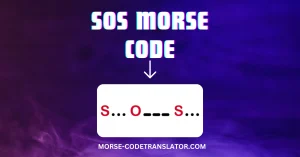
SOS (· · · – – – · · ·):
The most famous signal in history, used universally as a distress call.

CQ (– · – · – – · – ·):
A general call used by radio operators to invite anyone listening to respond.

SK (· · · – · –):
Meaning “End of Transmission.”

Even today, SOS remains recognized in both audio and visual formats! Whether it’s a flashlight signal, tapping sound, or radio tone.

The Science Behind Morse: Why It Still Works

You might wonder, why is Morse code still in use when we have the internet, satellites, and smartphones? The answer lies in its simplicity and reliability.
Unlike voice communication, Morse code:

Works with minimal signal strength.

Can travel long distances without distortion.

Requires very little bandwidth.

Can be used through light, vibration, or electrical impulses.

This makes it ideal for emergency communication, amateur radio, and military backup systems.
Even when digital systems crash, a simple Morse key can keep people connected.

Morse Code in Aviation and Maritime Communication

For decades, International Morse Code was a lifeline in aviation and maritime systems.

  • Ships used it to identify themselves and send weather or safety messages.
  • Aircraft beacons (NDBs) transmitted Morse-coded station identifiers.
    For example, if a navigation beacon identifies as “DXR,” it would transmit – · – · – – · – · in Morse.
  • Even after digital communication took over, pilots and seafarers still learn Morse basics as part of safety training.

Morse Code in Modern Times

Although Morse is no longer essential for military or commercial radio, it remains a favorite among hobbyists and emergency communicators.

  • Amateur radio operators (HAMs) use it for long-distance communication on low power.
  • Astronauts have used Morse signals as emergency tools in space missions.
  • Technology enthusiasts have turned Morse into art—creating apps, light shows, and even musical remixes using Morse patterns.

Fun fact: Beethoven’s Fifth Symphony (the iconic short-short-short-long rhythm) matches the Morse for “V” (· · · –), symbolizing “Victory” during World War II.

How to Learn International Morse Code

Learning Morse Code can be exciting—and easier than it looks. Here are some practical steps:

Start with the Sounds, Not the Symbols

Focus on hearing the patterns: “di” for dots, “dah” for dashes.

Use Audio Practice Tools

There are many free apps and websites that let you practice sending and receiving Morse at different speeds.

Practice Regularly

Consistency is key. Even 10 minutes a day can help you improve recognition speed.

Send Real Messages

Try flashing your name with a torch or using tapping sounds with a friend. The goal is fluency through rhythm.

Join an Online Morse Community

Ham radio clubs and online groups can help you practice with real operators.

Morse Code as a Universal Language of Humanity

In a world ruleMorse code isn’t just a relic of the past—it’s a living symbol of how humans have always found ways to communicate, even with the simplest tools. It’s a bridge between technology and emotion, connecting people through light, sound, and persistence.
From telegraph lines to satellites, from ships to smartphones, International Morse Code has evolved while keeping its timeless simplicity. It reminds us that even in an age of instant communication, the power of a simple signal can still save lives. By smartphones and instant messages, it’s easy to forget that communication once relied on dots and dashes. Yet, the Morse Code Alphabet A to Z still stands as a timeless reminder of human creativity and problem-solving.
What makes it special is its simplicity and power! Just a few short and long signals that can cross oceans, save lives, and share messages when nothing else works. Learning Morse code today isn’t just about nostalgia; it’s about training your brain to think faster, sharper, and more rhythmically.
Think of it as learning a secret language! One that connects you with history’s explorers, aviators, and innovators, while sharpening your focus and memory in the digital age.

Frequently Asked Questions

What is the difference between International and American Morse Code?

International Morse Code is the global standard adopted by the ITU, using simplified and consistent patterns. American Morse was an older version used primarily in the United States with more complex spacing.

Why is Morse Code still used today?

Because it’s reliable in weak-signal conditions where voice communication fails! Especially in aviation, maritime, and amateur radio systems.

How fast can Morse Code be sent?

Proficient operators can transmit at 20–30 words per minute, while world-class experts can reach over 50 WPM.

What does SOS mean in Morse Code?

SOS = · · · – – – · · ·. It doesn’t stand for specific words but was chosen because it’s simple, clear, and recognizable.

Can you send Morse Code without equipment?

Yes! You can tap it, blink it, or flash it with light—anything that can alternate between short and long signals can send Morse Code.

Related Blogs