Morse

How Does Morse Code Work? A Simple Guide to Dots & Dashes

Have you ever watched an old movie where someone urgently taps a small metal key, sending a pattern of dots and dashes through a cable? That rhythmic language is Morse code, one of the earliest and most brilliant communication systems ever created.

Even in the digital age of instant messaging, emojis, and voice notes, Morse code still stands out for its creativity and simplicity. But how does Morse code actually work, and why is it still remembered today? Let’s uncover the story, science, and secrets behind this fascinating code, and see how tools like a Morse code translator can bring it to life again.

How Does Morse Code Work

The Spark That Started It All – The Story Behind Morse Code

The story of Morse code began in the early 1800s with Samuel F. B. Morse, an American painter turned inventor. His interest in communication started with a personal tragedy. In 1825, while painting in Washington, Morse received a letter saying that his wife was seriously ill back home. By the time he returned, she had already passed away. The heartbreaking delay made him realize how slow long-distance communication was at that time.

Determined to find a faster method, Morse teamed up with Alfred Vail to develop a system that could send messages using electric signals. These signals traveled through wires and were received as short or long electrical pulses, which represented letters and numbers.

On May 24, 1844, Samuel Morse sent the first official telegraph message from Washington, D.C., to Baltimore. The message read: “What hath God wrought?” That simple moment marked the birth of Morse code and changed the future of communication forever.

What Exactly Is Morse Code?

In simple words, Morse code is a communication system that uses a series of short and long signals to represent letters, numbers, and symbols.

  • A dot (also called a dit) represents a short signal.
  • A dash (also called a dah) represents a long signal.

For example:

  • The letter E is represented by a single dot (.)
  • The letter T is represented by a single dash (-)
  • The letter C looks like this: (-.-.)

Each letter or number has its own unique pattern, making it possible to send complete messages using only sound, light, or electrical pulses. The mechanism dates back to when Morse Code was invented in the 19th century.

The Secret Rhythm – How Timing Makes It Work

Morse code is not just about dots and dashes; it’s all about timing. The pauses and lengths of each signal decide what message is being sent.

Here’s how it works:

  • A dot is the basic unit of time.
  • A dash lasts three times longer than a dot.
  • The space between dots and dashes within the same letter is equal to one dot.
  • The space between letters equals three dots.
  • The space between words equals seven dots.

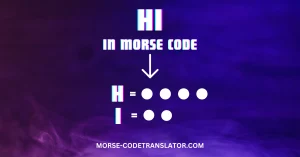
Let’s take an example:

  • H = (….)
  • I = (..)
Timing Makes

Morse Code in Action – From Wires to Radio Waves

In the beginning, Morse code was used through telegraph wires. People sent electric pulses that traveled along the wire to a receiver, which translated them into clicks or marks on paper.
But soon, Morse code found many new ways to travel.
Here are a few amazing examples:

Radio communication:
Ships used Morse code to send messages across oceans long before satellite phones existed.

Eye blinking:
One of the most powerful examples is that of Jeremiah Denton, a U.S. Navy pilot captured during the Vietnam War.

Sound tapping:
During wars, soldiers used tapping on walls or pipes to secretly communicate with Morse code.

Light signals:
Naval ships flashed light signals at night using special lamps known as Aldis lamps.

Morse code proved that messages could be sent through any medium — sound, light, or even small movements — as long as there was rhythm and precision.

The Evolution – From American to International Morse Code

Originally, Morse code had two different versions.

  • American Morse Code: This was the first version used for telegraphs in the United States. It had complex timing rules and some very long dashes.
evulution of morse code
  • International Morse Code: Created by Friedrich Clemens Gerke in 1848, this version was simplified and easier to understand.
International Morse Code

The international version quickly became popular and is still used today. It is also the format used in most online Morse code translators.

The Famous SOS Signal – The Universal Call for Help

One of the most famous Morse code messages is SOS, the universal distress signal.
In Morse code, SOS looks like this:
… — …
That means three short signals, three long signals, and three short signals again.
It was officially adopted as a distress call in 1905 because it was easy to send, recognize, and remember. It didn’t stand for any specific words, but many people later associated it with phrases like “Save Our Ship” or “Save Our Souls.”
Even today, tapping or flashing SOS is a quick way to signal for help when technology fails.

The Morse Code Alphabet and Numbers

Here is a quick reference table for the Morse code alphabet and numbers:

Letter

Code


Letter

Code

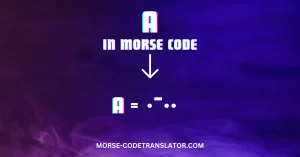
A

.-


N

-.

B

-…


O

C

-.-.


P

.–.

D

-..


Q

–.-

E

.


R

.-.

F

..-.


S

G

–.


T

H

….


U

..-

I

..


V

…-

J

.—


W

.–

K

-.-


X

-..-

L

.-..


Y

-.–

M


Z

–..

Numbers:
1 = .—-
2 = ..—
3 = …–
4 = ….-
5 = …..

Numbers:
6 = -….
7 = –…
8 = —..
9 = —-.
0 = —–

These simple combinations form the foundation of Morse code communication. Once you memorize them, you can start creating your own coded messages instantly. Successful transmission requires a good understanding of timing when using the Morse Code Key.

How to Decode Morse Code – Learning to Read the Rhythm

Decoding Morse code is like learning to play music. You listen for patterns and translate them into letters and words.

Here’s the basic process:

  1. Listen carefully to the sequence of short and long signals.
  2. Identify each signal as a dot or a dash.
  3. Group the signals together to form a letter.
  4. Use the pauses to separate words.

If you are new to it, the easiest way is to use a Morse code translator. You can enter dots and dashes like this: …. . .-.. .-.. — and it will instantly translate it into “HELLO.”

Morse Code in Pop Culture

Morse code’s mystery and simplicity have made it a star in pop culture too.

  • Movies and TV Shows: From Interstellar to Breaking Bad, Morse code has been used to send hidden messages or emotional signals.

  • Music: Some artists have used Morse beeps in songs to spell secret words.

  • Games: Puzzle and mystery games often hide Morse messages as clues, adding a sense of discovery.

Its charm lies in the fact that even a simple tap or blink can carry deep meaning.

Modern Uses of Morse Code

Even in the age of instant messaging and voice recognition, Morse code still plays an important role in certain fields. It’s not as common as before, but it hasn’t disappeared either.

1. Aviation and Navigation

In aviation, Morse code is still used in radio beacons and navigational aids. For instance, when pilots tune into a specific navigation frequency, they can identify the beacon by its Morse code signal. Each airport or beacon has its own unique Morse identifier, ensuring pilots know exactly where they are heading, even in poor visibility.

2. Amateur Radio (Ham Radio)

Ham radio operators continue to use Morse code as a universal language. It allows communication over long distances with very weak signals. In fact, Morse code can often get through when voice communication fails due to interference or low power. Enthusiasts often see Morse as an art form that connects generations of radio lovers.

3. Military and Special Operations

While encrypted communication dominates military use today, Morse code is still taught for backup communication methods. Its reliability and simplicity make it valuable in certain covert or emergency operations.

4. Emergency Signaling

Morse code is still one of the simplest ways to send a distress signal when technology fails. The famous SOS (… — …) can be tapped, flashed, or even blinked with light. People have used Morse code to signal from boats, mountains, and even through soundproof barriers.

5. Assistive Technology for Communication

Morse code has been adapted for people with disabilities. Some assistive devices allow individuals with limited movement to communicate using switches or blinks that translate Morse inputs into words. For example, people with ALS (like the late Stephen Hawking) could benefit from systems inspired by Morse principles.

The Art of Learning Morse Code

Learning Morse code can be fun and surprisingly rewarding. It sharpens your memory, improves focus, and gives you a unique skill that few people today have.

1. Start with the Sounds, Not the Dots and Dashes

Instead of memorizing visual patterns, listen to the rhythm of Morse. The sound-based method helps you process messages faster. For example, “S” sounds like di-di-dit, while “O” is dah-dah-dah.

2. Daily Drills

Spend 10–15 minutes each day listening and decoding. Apps and websites can play random Morse letters or words. Gradually, you’ll start recognizing entire words by sound alone, just like learning a new language.

3. Use Patterns and Mnemonics

Some learners use simple phrases or patterns. For example:

  • C = dah-di-dah-dit (think of it as a “cheerful clap” pattern)
  • R = di-dah-dit (sounds like “run”)
    Such tricks make memorization easier and fun.

4. Practice with Real Tools

Your best digital helper is a Morse Code Translator. It allows you to:

  • Type messages and see the Morse output instantly.
  • Listen to the sound version to practice your ear.
  • Convert back from Morse to text for decoding drills.

Fun Morse Code Facts

Here are some quick and fascinating facts about Morse code that might surprise you:

  • The shortest Morse symbol is for the letter E (a single dot).
  • The longest one is for 0 (five dashes).
  • During World War II, Morse code operators were called “Sparks.”
  • The @ symbol was officially added to Morse code in 2004 – over 160 years after its invention.
  • The fastest Morse code speed ever recorded was 75.2 words per minute.

Morse Code and Our Translator

Morse code may feel like a thing of the past, but with our Morse Code Translator, it becomes exciting again. You can:

  • Instantly convert text to Morse and hear how it sounds.
  • Decode Morse signals from recordings or images.
  • Send fun secret messages to your friends.
  • Explore how words translate into dots and dashes in real time.

It’s not just a tool – it’s a modern bridge to one of history’s most fascinating communication systems.

Frequently Asked Questions

What is Morse code used for today?

It’s used in aviation, amateur radio, emergency signaling, and even in assistive communication devices.

How is Morse code sent?

It can be transmitted through sound, light, or touch — using beeps, flashes, or taps that represent dots and dashes.

How can I learn Morse code fast?

Use a Morse code translator, practice listening instead of reading, and start with common letters like E, T, A, and N.

What’s the meaning of SOS in Morse code?

SOS is … — …, meaning “Save Our Souls.” It’s the international distress signal.

Can Morse code be used secretly?

Yes. Many people use Morse code for hidden messages, game puzzles, or private communication.

Related Blogs