
Morse

L in Morse Code: Meaning, History, and Practical Applications

Morse code is one of the most fascinating communication systems that has ever been invented, and it was invented in the 1830s by Samuel Morse and Alfred Vail. Unlike contemporary text or voice communication, Morse code encodes letters, numbers, and symbols with a combination of dots (·) and dashes (–). The sequences are unique and hence an effective, dependable and small way of conveying messages.

In this article, we shall be talking about the letter L in Morse code. We shall address its meaning, history, practical use and how you can study it today. We shall also talk about how it is used in such phrases as I L Y in Morse code and how Morse code translators simplify the process of learning.

What is L in Morse Code?

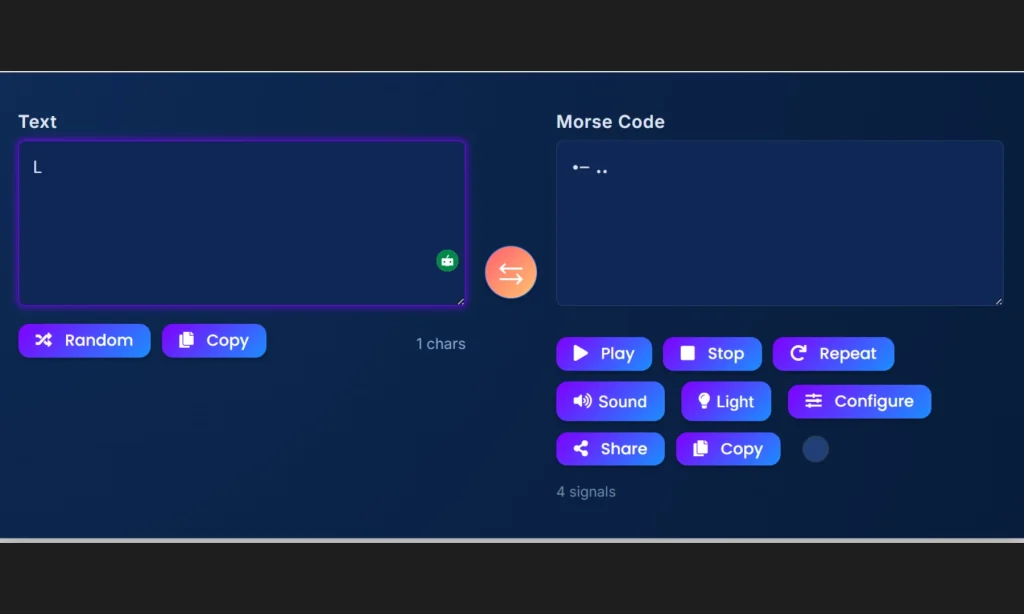
Morse code L is translated to · – -. This series of a dot, dash, dot, and dot makes the letter stand out among others, even when sent at a high speed. The length of each element is specific:

  • Dot (·): a short signal
  • Dash (–): three times longer than a dot

Timing and spacing are critical: there should be a pause of one dot between symbols in a letter, three dots between letters, and seven dots between words.

Knowledge of these rules is significant in proper communication, particularly in high-stakes conditions like in aviation, maritime signaling, and emergency cases.

Historical Importance of the Letter L

During the early telegraphy, Morse code was a breakthrough in long-distance communication. The letters were to be easily differentiated. The dot-dash-dot shape of the letter L was intentionally made to be distinct enough not be confused with such letters as A (· –) or F (· · – ·).

Morse code was necessary in maritime and military communications. As an illustration, naval operators used codes with L in distress or navigational messages. In World War II, each letter was to be sent with accuracy. A wrong letter might result in a mission failure or even death.

Even nowadays, reading the historical background of such letters as L provides an idea of the genius of the Morse code design.

How to Write L in Morse Code

Writing L is simple in theory, but requires attention to timing:

  1. Tap a short dot (·)
  2. Tap a long dash (–)
  3. Tap a short dot (·)
  4. Tap a short dot (·)

The sequence should be conveyed in a transparent manner, with the proper pauses between symbols.

Practical Methods:

  • Sound: Use a whistle, buzzer, or tapping device to send the dot and dash rhythm.
  • Light: Flash a torch or signal lamp to indicate dots and dashes.
  • Touch: Tap out the sequence on a surface for silent communication.

Proper execution will make sure that your audience can read the letter correctly even in your absence.

Fun Facts About L in Morse Code

Easy to Learn

L is among the easiest letters that a beginner can memorize because of its combination, dot, dash, dot, dot.

Used in Famous Codes

Letters like L appear in distress codes, navigational sequences, and historical military messages.

Emotional Significance

L is crucial in messages like I L Y, showing Morse code can convey love and affection, not just information.

Using Morse Code Translators

A Morse code translator is a necessity for beginners. These tools allow you to:

  • Translating letters, such as L, into Morse code in real time.
  • Hear the sound of the rhythm of every letter.
  • Write or type letters correctly.

As an example, when typing L in a translator, it shows · – – -, and it usually has a sound. Other sophisticated translators allow you to type in complete phrases such as I L Y, and the entire Morse code appears. These translators assist learners in visualizing and practicing Morse code effectively.

what is L in morse code

Common Mistakes When Writing L

Mistakes often occur in Morse code learning, even with simple letters like L:

  • Dot and dash confusion: Misjudging the length of a dash can change the letter entirely.
  • Spacing errors: Incorrect pauses between symbols or letters make decoding difficult.
  • Missing context: The inability to differentiate letters in such phrases as I L Y can cause misinterpretation.

A translator or a partner can be used to minimize these mistakes.

Practical Applications of L in Morse Code

Morse code might be outdated, but it is still applicable nowadays:

  • Aviation: Navigational beacons often use Morse sequences, including L as part of airport identifiers.
  • Amateur Radio: Ham operators use L in greetings, coded messages, and international communication.
  • Emergency Situations: In survival or remote scenarios, the letter L could be part of SOS signals or personalized codes.

L in Morse code is still helpful even in a digital era, which testifies to its immortality.

Letter L in Words and Phrases

Letters are living when they are applied in words. The letter L is critical in emotionally or practically colored phrases:

  • I L Y in Morse code: The abbreviation I Love You has the letter L. In Morse code, it would be coded as: · – – – (L), – (I), and – – – (Y). Even such a simple combination can be a sophisticated coded expression of affection.
  • I love you in Morse code: The use of L in phrases makes it more valuable than its technical use. It connects the world of communication and emotion, demonstrating that Morse code is not only used in cases of emergency but also in uniting hearts.
L in morse code

Real-Life Examples of L in Morse Code

To understand L in practical terms, it helps to look at real-life examples:

Navigational Codes

In aviation and maritime navigation, identifiers often include the letter L. For example, an airport beacon might transmit · – · · as part of its Morse code identifier to communicate location. Pilots and sailors decode these signals instantly, even from miles away.

Messages of Affection

  1. The phrase I L Y in Morse code demonstrates Morse code’s emotional side. Instead of relying on modern texting, lovers or friends could encode a message with · – · · (L), · (I), and –·–·– (Y). Such messages are discreet, elegant, and carry a personal touch.

Emergency Signaling

In survival situations, Morse code allows for silent or long-distance communication. The letter L may appear as part of a distress message like “HELP” (· – · · · · · · – ·). Knowing L ensures clarity in life-saving messages.

Table of Common Words Containing L

Learning letters in isolation is helpful, but seeing L in context strengthens memory. Here’s a table of common words containing L, with their Morse code sequences:

Word

Morse Code

Notes

LOVE

· – · · –··– ··· –···

Combines L with other letters in affection

LIGHT

· – · · · · – · –··

Useful in navigation or signaling

LEARN

· – · · · · – · · –··

Educational and motivational use

LUCK

· – · · –·– ––·

Often used in coded messages

LIFE

· – · · ·· – –· ·

Common in emergency communication

Practicing words like these helps learners internalize the rhythm of L in various contexts.

Learning Tips for L in Morse Code

Learning L effectively involves combining visual, auditory, and practical exercises:

  • Visual practice: Write · – · · repeatedly until the pattern becomes instinctive.
  • Audio practice: Listen to Morse code recordings to recognize L’s sound.
  • Word practice: Include L in words like LOVE, LIGHT, and LEARN to see it in context.
  • Use translators: Instant feedback from Morse code tools helps correct mistakes early.

Through constant practice, the letter L will become second nature, and one will be able to communicate even in a stressful situation.

Step-by-Step Exercises for Mastering L

To ensure you remember L perfectly, here’s a practical exercise routine:

  1. Write it repeatedly: Copy · – · · at least 50 times on paper.
  2. Tap it out: Use a pen, desk, or Morse key to tap the sequence rhythmically.
  3. Flash it with light: Use a flashlight to signal L across a short distance.
  4. Audio drill: Listen to a Morse code audio track and identify when L occurs.
  5. Integrate in words: Practice words like LOVE, LIGHT, and LEARN to strengthen contextual recognition.
  6. Use a translator: Enter L in a Morse code translator and match it with your efforts.

The exercises build speed and accuracy, and you can use L with confidence in messages.

Anecdotes of History Featuring L

Letters such as L might not appear extraordinary, but history provides meaning to them:

World War II Communication: Morse code was used by the naval officers to pass orders between ships. The letter L was commonly used in location markers and maneuver codes in sequences. Errors may lead to the ship crashing or the failure of missions.

Aviation Navigation: In the 1920s and 30s, pilots used Morse code beacons to guide them. The letter L, which was part of beacon identifiers, was essential for safe landings, particularly during the night or when there was poor weather.

Romantic Letters: Sometimes soldiers on the front lines sent home with Morse code-coded letters. Morse code letters, such as L in I L Y, enabled them to send love messages in a secretive manner, and messages made it through long distances.

Through these stories, it is demonstrated that Morse code is not merely dots and dashes but a bridge through time, space and emotion.

Contemporary Significance of L in Morse code

Although digital communication is widespread, Morse code is still surprisingly topical:

  • Amateur Radio Communities: Ham radio users still communicate over long distances using Morse code. L is used in greetings, call signs, and messages.
  • Emergency Preparedness: Survivalists and outdoor adventurers study Morse code, such as L, to communicate in case of an emergency when there is no cell service.
  • Educational Resources: Learning Morse code, which begins with the letters L, can be used to enhance memory, auditory, and pattern recognition.
  • Morse Code Apps and Translators: Online applications enable anyone to train L and other letters. They offer visual, audio and interactive activities, and learning is available to everyone.

Fun Activities to Practice L

These are some of the innovative methods to strengthen your L:

  • Flashlight Messages: Use a torch to write L on a wall, and make a friend guess what it means.
  • Tap Games: Tap words on a desk to make words such as LOVE or LEARN.
  • Audio Quizzes: Recording Morse code sequences and drilling yourself on identifying L.
  • Morse Code Art: Use letters to create decorative patterns, e.g., L in dots and dashes.

With these exercises, learning Morse code is fun, and skills and confidence are developed.

Frequently Asked Questions

What is L in Morse code?

In Morse code, the letter L is denoted with one dot, one dash, and two dots: · – ·.

How do I write L in Morse code?

The sequence of tapping or signaling to write L is as follows: short dot, long dash, short dot, short dot. Always remember to stop in between symbols.

What is the meaning of I L Y in Morse code?

I L Y is an abbreviation of I Love You, and a line, a line, a line denote the letter L in the phrase. It is a standard method of sending loving messages using Morse code.

Is it possible to transmit L in Morse code by light or sound?

Yes! You may send L as a visual or audio signal using a flashlight, torch, buzzer, or tapping device.

Is it challenging to learn L in Morse code?

Not at all! L is regarded as one of the simplest letters to master due to a simple dot-dash-dot-dot pattern. Training in words and a Morse code translator to learn faster.

Related Blogs

L in Morse Code

L in Morse Code

L in Morse Code: Meaning, History, and Practical Applications Morse code is one of the most fascinating communication systems that...
Read More →