J in Morse Code: Symbol & Translation
One of the most interesting and ancient systems of communication is Morse code. It does not use verbal communication or written letters but uses a system of short and long signals to convey a message. These can be sent by sound, light or even physical movement. J is the only letter in the Morse code alphabet that has a unique rhythm and usefulness in real-life scenarios.
When you have ever typed the letter J in a Morse code translator, you likely have noticed how the pattern of the letter appears in comparison with other letters. This paper discusses the meaning, history, practical application and learning worth of letter J in Morse code with clear explanations and practical examples.
What Is J in Morse Code?
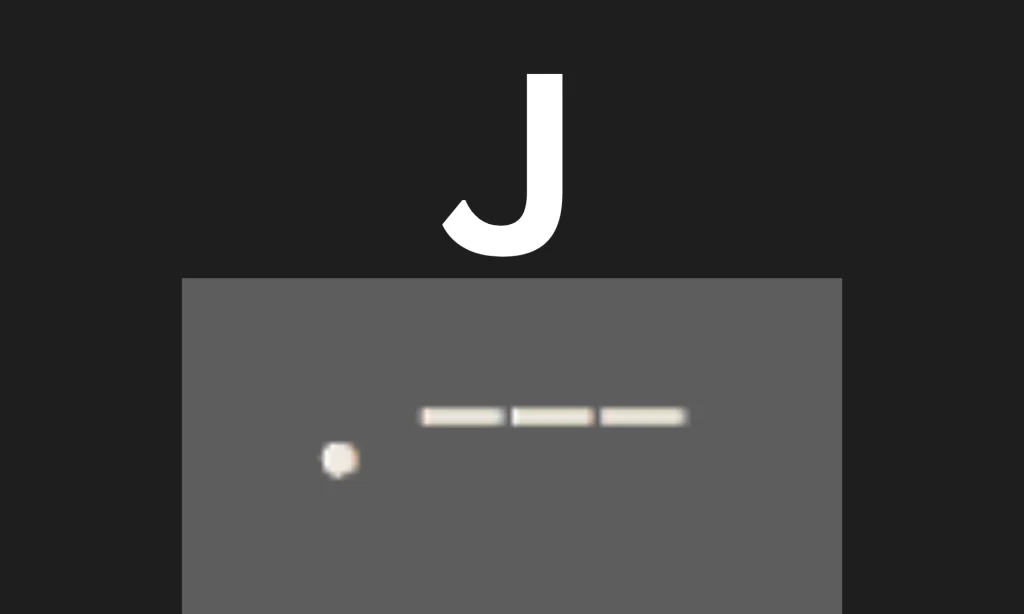
The exact Morse representation for J is · – – –, which is often spoken aloud as:
“dit dah dah dah”
It is a type of vocal that can assist learners in memorizing the rhythm of the signals. The dot is denoted by the short mark of dit, and the dashes are denoted by the longer mark of dah.
This is a straightforward pattern that makes J one of the simplest letters to identify after you get familiar with the Morse timing.
Why the Letter J Has a Unique Rhythm
Most Morse code letters have a combination of dots and dashes; however, J is a special letter as it contains:
- Only one dot
- Followed by three dashes
This creates a strong, flowing rhythm that sounds almost musical when played through audio signals. Compared to shorter letters like E (·) or T (–), J takes longer to transmit, but it’s very clear and hard to confuse with other letters.
Letter J in Morse Code for Beginners
For people just starting to learn Morse code, J is often introduced after simpler letters like E, T, and A. While it’s slightly longer, its clear structure makes it easy to memorize.
- A simple memory trick:
- “J jumps three times.”
- The dot is the jump, and the three dashes are the long landings.
How Morse Code for J Is Transmitted
The letter J can be sent using different methods, as long as the timing between dots and dashes is correct.
1. Sound Signals
- A dot is a short beep.
- A dash is a longer beep.
- So J sounds like:
- Beep — BEEP — BEEP — BEEP
2. Light Signals
Using a flashlight:
- Quick flash
- Long flash
- Long flash
- Long flash
3. Tapping
- One quick tap, followed by three longer taps.
- No matter the method, the timing stays the same.
Using a Morse Code Translator for the Letter J
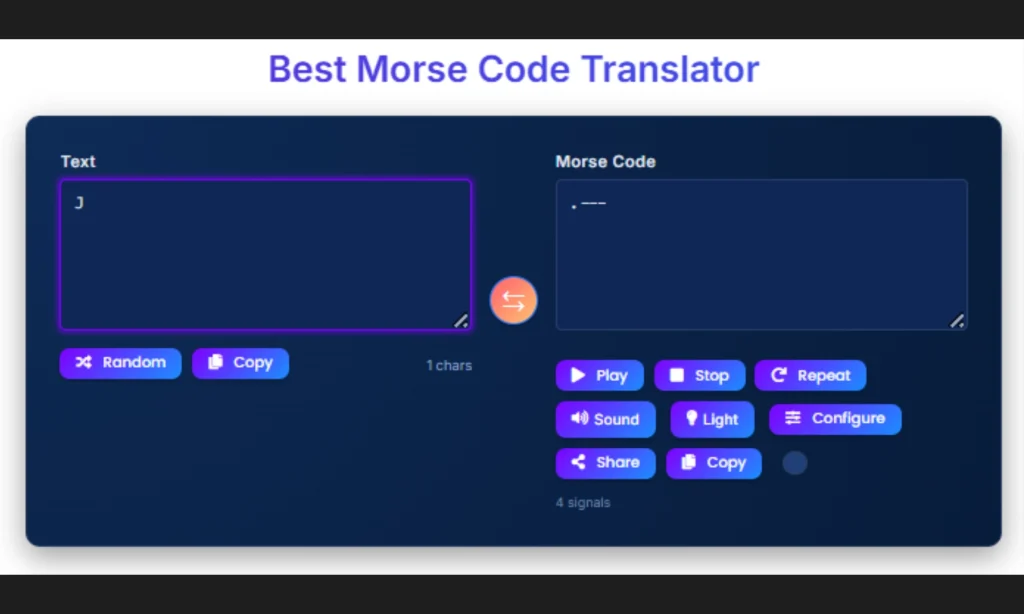
Modern Morse code translators make learning much easier. Instead of memorizing charts, you can simply type a letter and see its Morse pattern instantly.
In the image shown, our Morse Code Translator displays:
- The typed letter J
- The Morse output · – – –
- Options to play the sound
- Light signals for visual learning
- Copy and share features
This makes it easy for beginners to:
- Hear the correct rhythm
- See the timing visually.
- Practice sending and receiving signals.
You can also convert full words that start with J to see how the letter fits into longer messages.
Why J Matters in the Morse Alphabet
Every letter in Morse code serves a purpose, but J has exceptional value because:
- It’s easy to recognize
- It has a strong rhythm.
- It’s commonly used in names.
- It helps learners practice timing.
The longer pattern of J helps students understand how dash length affects message clarity.
How Morse Code Timing Works for J
Timing is the heart of Morse code. The length of each signal matters more than the sound itself.
- Dot = 1 time unit
- Dash = 3 time units
- Pause between signals = 1 unit
- Pause between letters = 3 units
So when sending J, the sender must maintain proper spacing to avoid confusion with other letters.
A Quick Look at Morse Code as a Communication System
It is helpful to get some idea of how Morse code functions before concentrating on the letter J. The invention of Morse code in the early nineteenth century was meant to transmit messages over long distances with the help of electrical signals. Instead of letters, it uses:
- Dots (short signals)
- Dashes (long signals)
All the letters of the alphabet are combined in their own way with dots and dashes. These patterns are meant to be remembered easily, either through hearing or seeing.
Morse code has been used in:
- Military communication
- Maritime navigation
- Aviation signaling
- Emergencies
- Amateur (ham) radio
- Assistive communication tools
Morse code is still applicable today as a backup communication system when modern technology is not functioning.
The Morse Pattern for the Letter J
The Morse code of the letter J is prominent and recognizable:
- – – –
This means:
- One short signal (dot)
- Followed by three long signals (dashes)
Due to this structure, J has a good, constant rhythm, which makes it easier to detect when listening to Morse code by sound.
When you can hear a short beep and then three longer beeps, then there is a high probability that the signal is the letter J.
Real-Life Situations Where J Was Used in Morse Code
1. Maritime Communication
Ships used Morse code to send navigation updates, warnings, and identification signals. If a ship’s name started with J, the first signal transmitted would often be the J pattern.
2. Amateur Radio (Ham Radio)
Radio operators still use Morse code today. Operators with names like James, John, or Jack often hear the J pattern frequently when exchanging call signs.
3. Emergency Signaling
In survival situations, knowing Morse code can save lives. If someone wanted to signal their name or location starting with J, the · – – – pattern would be used.
4. Military Messaging
During wartime, Morse code was used to send short, coded messages. Letters like J were part of encrypted signals and mission updates.
A Quick Look at Morse Code as a Communication System
It is helpful to get some idea of how Morse code functions before concentrating on the letter J. The invention of Morse code in the early nineteenth century was meant to transmit messages over long distances with the help of electrical signals. Instead of letters, it uses:
- Dots (short signals)
- Dashes (long signals)
All the letters of the alphabet are combined in their own way with dots and dashes. These patterns are meant to be remembered easily, either through hearing or seeing.
Morse code has been used in:
- Military communication
- Maritime navigation
- Aviation signaling
- Emergencies
- Amateur (ham) radio
- Assistive communication tools
Morse code is still applicable today as a backup communication system when modern technology is not functioning.
The Morse Pattern for the Letter J
The Morse code of the letter J is prominent and recognizable:
- – – –
This means:
- One short signal (dot)
- Followed by three long signals (dashes)
Due to this structure, J has a good, constant rhythm, which makes it easier to detect when listening to Morse code by sound.
When you can hear a short beep and then three longer beeps, then there is a high probability that the signal is the letter J.
Table of Common Words Containing L
Learning letters in isolation is helpful, but seeing L in context strengthens memory. Here’s a table of common words containing L, with their Morse code sequences:
Word | Morse Code | Notes |
· – · · –··– ··· –··· | Combines L with other letters in affection | |
LIGHT | · – · · · · – · –·· | Useful in navigation or signaling |
· – · · · · – · · –·· | Educational and motivational use | |
LUCK | · – · · –·– ––· | Often used in coded messages |
LIFE | · – · · ·· – –· · | Common in emergency communication |
Practicing words like these helps learners internalize the rhythm of L in various contexts.
The Role of J in Learning Morse Code Faster
Learning Morse code becomes easier when you focus on rhythm instead of visual symbols. The letter J has a smooth, predictable rhythm that helps learners:
- Improve listening skills
- Recognize long signal patterns.
- Build confidence
Many Morse trainers use J as a practice letter for rhythm exercises.
How the Letter J Is Used in Names and Call Signs
In radio communication, people often use call signs that include letters like J. For example:
- JA1XYZ (Japanese call sign)
- John
- James
Hearing the J pattern frequently helps operators recognize personal identifiers quickly.
The Letter J in Morse Code for Children
Teachers often introduce Morse code to children through games. J is a fun letter because:
- It has a “jumping” rhythm
- It sounds dramatic
- It’s easy to act out with hand movements.
Kids can tap one short beat and three long beats to spell J.
Using J in Secret Messages
Morse code is often used for fun, secret messages between friends. If your message starts with a J, it instantly looks more complex and mysterious.
Example:
“JOKE”
Starts with a strong J signal.
What’s J in Morse Code?
In simple terms, J is written as · – – –. This pattern stays the same across all standard Morse code systems used worldwide.
Fun Fact About J in Morse Code
The J pattern looks similar to the number 1, which is · – – – – (one dot, four dashes). The only difference is that J has three dashes instead of four.
This similarity helps learners remember both patterns easily.
Letter J in Morse Code for Visual Learners
Some people learn better by seeing instead of hearing. For them, the visual version of J looks like:
- — — —
Seeing the long lines after the dot helps reinforce memory.
The Letter J in International Signaling
Most countries use the same Morse code. It implies that the letter J is interpreted in every part of the world, and it can be used in international communication.
The Emotional Impact of Morse Code Letters
There are letters that are short and sharp. Some, such as J, are confident and balanced. This emotional beat renders Morse code a pleasant thing to study and a nice thing to play with.
Historical Importance of the Letter J in Signaling
While Morse code was originally designed for English, it later became a global communication system. The letter J was standardized early on, ensuring that people from different countries could understand each other’s signals.
This standardization helped:
- Ships communicate internationally
- Pilots send distress signals.
- Military units coordinate missions.
The Letter J in Modern Technology
Even today, Morse code appears in:
- Mobile apps
- Learning platforms
- Accessibility tools
- Online translators
These aids allow one to navigate letters such as J without learning charts.
The Letter J in Morse Code Crossword Clues
There are also puzzles and crosswords that are based on clues in Morse code. One of the clues would require a letter with one dot and three dashes, and the response would be J.
How to Practice the Letter J Effectively
To master J:
- Listen to the sound
- Repeat the rhythm
- Tap it out
- Use a translator tool.
- Try writing words with J.
The practice will make your brain aware of the pattern.
Famous Words That Start with J in Morse Code
Some commonly used words beginning with J include:
- Job
- Jump
- Join
- Just
- July
When transmitted in Morse code, each of these words begins with the same J pattern. This consistency helps operators quickly recognize the start of a message.
Final Thoughts
The letter J can be just another character of the Morse alphabet, but it has a significant role in communication, learning, and history. Its powerful rhythm, definite pattern, and its practical application make it worthwhile to both beginners and experts.
Using contemporary technology such as our Morse Code Translator, anyone can experiment with the pattern of J by sound, light and text. Learning the Morse code to have fun, to learn or to be prepared in case of an emergency, knowing the letter J is a good step to go.
Frequently Asked Questions
What is the Morse code for J?
The Morse code for J is a dot followed by three dashes: · – – –.
Why does J have such a long signal pattern?
Because J is used less often than some other letters, it was given a longer pattern to balance the Morse code system.
Can J be sent using light signals?
Yes. You can flash one short light and then three long flashes to send the letter J.
Is J complex to learn in Morse code?
Not really. Its rhythm is simple and easy to recognize once you hear it a few times.