Love in Morse Code: The Beautiful Symbol for Romance
Love has always found a way to speak through words, looks, gestures, and even silence. But imagine expressing it through rhythm, light, or sound in a way that only two people can understand. That is what makes Love in Morse code so beautiful. It turns emotion into a secret signal, a pattern that is both simple and timeless.
This guide will help you learn how to write, read, and feel the word Love in Morse code. You will also discover how people use it creatively in jewelry, art, and digital communication. A small word that carries enormous meaning, encoded in dots and dashes.
What Is Morse Code and Why It Still Matters
Morse code is one of the oldest communication systems still understood around the world. It uses combinations of dots (.) and dashes (-) to represent each letter, number, and symbol. Instead of using words or voices, you communicate through rhythm, using short and long signals that can be seen, heard, or felt.
It might seem old-fashioned, but Morse code remains surprisingly relevant. Its simplicity makes it universal. You can use it with lights, sounds, vibrations, or even tapping on a wall. People still use it in aviation, maritime signals, and creative projects like art and jewelry.
It is part of the morse code alphabet, a full set of symbols representing A to Z and 0 to 9. When you learn one word, you unlock the logic behind them all, and Love is a perfect place to start.
How to Say “Love” in Morse Code
Let’s break it down clearly.
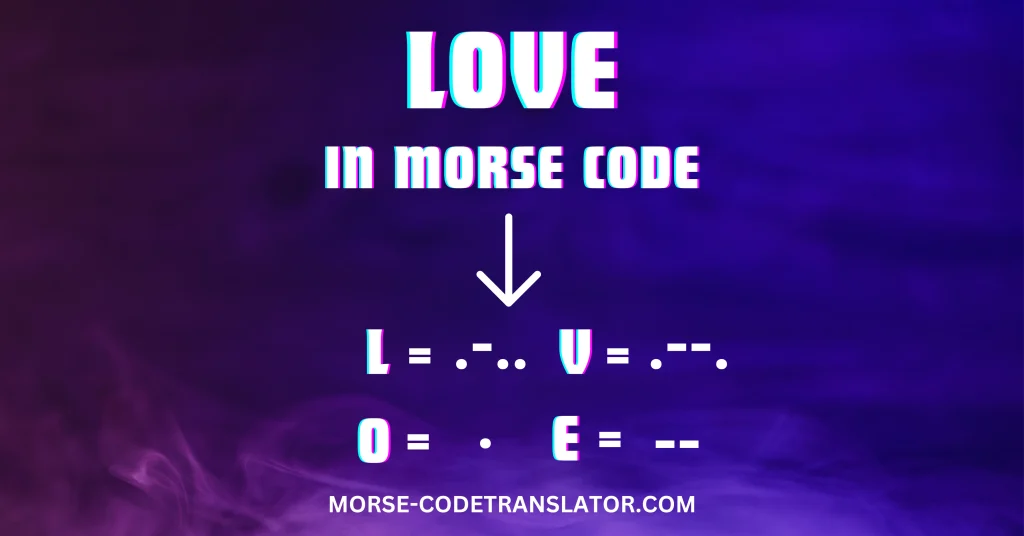
Word: LOVE
L = .-..
O = —
Word: LOVE
V = …-
E = .
So, the complete Morse code for Love is:
LOVE = .-.. — …- .
If you were to say it aloud using traditional Morse rhythm, it would sound like:
dit dah dit dit dah dah dah dit dit dit dah dit
Each dot is a short pulse or sound, and each dash is a longer one. If you listen to it or flash it using light, you can literally see the rhythm of the word “Love.”
You can also type “Love” into our Morse Code Translator to instantly hear how it sounds and see the visual pattern. It is a quick way to experience Morse in both sound and sight.
Similar Words to Learn After “Love”
Once you have learned how to say Love in Morse code, it is easy to expand your Morse vocabulary. Try out short and emotional words next:
- Hi in Morse code: …. ..
- Yes in Morse code: -.– . …
- No in Morse code: -. —
- Hello in Morse code: …. . .-.. .-.. —
And if you want to say more, learn I love you in Morse code which is written as:
.. / .-.. — …- . / -.– — ..-
Each new word teaches you new patterns and helps you remember letter combinations faster. The more words you learn, the closer you get to mastering the morse code alphabet A to Z.
The Rhythm and Timing of “Love”
Morse code is like music. Timing matters as much as the symbols themselves. Every letter, every pause carries weight.
Here is how to time it:
- Dot (.) = 1 time unit
- Dash (-) = 3 time units
- Space between parts of the same letter = 1 unit
- Space between letters = 3 units
- Space between words = 7 unit
To send Love, keep your rhythm even and consistent. The beauty lies in its simplicity, just like love itself.
If you were to tap it on a desk, flash it with light, or hum it, the sound would follow a gentle rhythm: quick taps for dots, slow ones for dashes, with brief pauses in between.
The Meaning Behind “Love” in Morse Code
Why does writing “Love” in Morse feel different than just saying it? Because it adds intention. It takes effort. You slow down, spell it out, and create something deliberate. It becomes a quiet, mindful gesture.
Morse code has long been used not only for communication but also for connection. Soldiers once sent Morse-coded messages home during wartime. Lovers sent hidden notes through short signals. In a world where everything moves fast, expressing love in code feels personal again.
Morse turns an everyday word into a symbol, a heartbeat turned into sound or light. It is less about secrecy and more about sincerity. That is the magic of it, the language of love stripped down to rhythm and patience.
How to Practice Saying “Love” in Morse Code
Learning Morse is not difficult once you get used to the rhythm. You can practice Love through three simple methods: sound, light, and digital tools.
1. Using Sound
Start by tapping or clapping the pattern of Love:
.-.. — …- .
- Quick taps for dots.
- Longer, drawn-out taps for dashes.
- Count short pauses between letters.
You can use a desk, wall, pen, or even your hand. After a few tries, your brain starts recognizing the flow automatically.
2. Using Light
If you prefer a visual challenge, grab a flashlight or use your phone’s torch.
- Short flashes for dots.
- Long flashes for dashes.
- Keep steady pauses.
This is one of the most satisfying ways to practice, especially in the dark. You can even flash “Love” to a partner across the room as your own secret code.
3. Using Our Morse Code Translator
For the easiest start, open our Morse Code Translator and type the word Love. The translator will instantly show you the dots and dashes and play the matching sound pattern.
Repeat it a few times until your ears and eyes recognize the rhythm. The translator also helps you avoid mistakes in spacing and letter timing, which is the hardest part for beginners.
Creative and Romantic Uses of “Love” in Morse Code
Learning “Love” in Morse code is more than a fun skill. It opens up creative ways to express affection.
1. Morse Code Jewelry and Gifts
Jewelry designers often use beads or lines to spell hidden Morse messages. For instance, a bracelet could use short beads for dots and longer ones for dashes, secretly spelling “Love.” It is meaningful, minimal, and personal.
You can even engrave . -.. — …- . on a ring or pendant as an elegant reminder of love in code form.
2. Tattoos and Minimalist Art
Some people choose Morse tattoos for words that mean the most to them. The word Love is perfect for this, subtle and deeply symbolic.
You can design it as a line of dots and dashes or blend it into another symbol like a heart, infinity sign, or heartbeat line.
3. Letters, Notes, and Messages
Add a hidden Morse line in a handwritten note, a text message, or even a social media bio. It is a quiet way to send affection to someone who knows what it means.
You can write:
.-.. — …- . under a photo or message, a code that says “Love” to those who can read it.
4. Home and Digital Design
From wall art to LED lights, Morse can turn simple spaces into emotional expressions. Some creators design glowing wall panels or patterns that pulse in Morse rhythm, spelling “Love.” It is romantic, modern, and timeless all at once.
Cultural and Historical Fun Facts
Romantic Morse in History
During the early 20th century, when long-distance communication relied heavily on radio and telegraph, Morse code became more than a tool of war or navigation. It became a quiet bridge between people separated by oceans, borders, and battles. Soldiers stationed overseas often sent personal messages back home using coded signals. Some of these carried short, heartfelt words such as “Love” or “I miss you,” hidden amid official transmissions.
Couples developed private codes to express affection without revealing their emotions publicly. A simple rhythmic tap on a wall, a flash of a lantern, or even a pause in a message could carry meaning that only one other person understood. These small acts made Morse a language of both survival and connection, blending discipline with deep emotion.
One famous story involves prisoners of war who communicated through the “tap code,” a simplified form of Morse. For many, it was not just a way to share information, but a way to say “I’m alive” or “I love you” under the harshest circumstances. Such uses show how Morse code transcended its technical roots to become a symbol of human resilience and care.
Movies and Media
Cinema and television have long been fascinated by Morse code because of its power to symbolize silence, secrecy, and persistence. In movies, it often appears as a heartbeat of hope, where characters use it to reach someone against all odds. In romantic scenes, Morse is sometimes woven into dialogue or visual storytelling as a metaphor for a hidden connection.
For example, films about wartime love stories often feature Morse as a bridge between two worlds: one at the front lines and one at home. Even in modern thrillers or sci-fi stories, Morse flashes through lights or sound as a nostalgic reminder of simpler yet more meaningful communication. Television shows and music videos also use it visually, embedding Morse sequences into lighting patterns, lyrics, or camera flashes.
The simplicity of dots and dashes captures the essence of suspense and emotion in one rhythm. It reminds viewers that even when people cannot speak directly, they still find ways to reach each other.
Art and Music
Artists and musicians have always been drawn to Morse code because of its poetic structure. Painters have used Morse-inspired sequences of dots and lines as design elements, turning coded messages into visual art. Some modern art pieces hide words like “Love,” “Peace,” or “Hope” in Morse, visible only to those who take time to decode them.
In music, composers have incorporated Morse rhythms into melodies and beats. A series of short and long notes can mirror the tempo of dots and dashes. Some bands have even hidden Morse sequences in songs as Easter eggs for fans to find. One well-known example includes patterns that spell words of affection or dedication to someone meaningful to the artist.
Why Morse Still Feels Human
What makes Morse so fascinating is how something so mechanical continues to feel alive. The code itself is just a pattern of signals, but behind each one is a person with intention and emotion. It is a form of communication stripped down to its purest form: timing, rhythm, and feeling.
Unlike digital text, Morse requires presence. You must listen, wait, and respond. That pause between signals is where empathy lives. The dots and dashes might be uniform, but the meaning behind them depends on the heart sending them. This is why Morse continues to appear in art, love stories, and music. It is not just communication; it is connection.
Common Mistakes When Learning “Love” in Morse Code
Learning Morse takes patience and consistency. Even a small mistake can change the entire meaning of a message. Here are some of the most common errors people make while practicing the word Love in Morse code and how to avoid them.
1. Incorrect Spacing
Spacing is the heartbeat of Morse. Forgetting to pause between letters can turn one word into another. For example, if you send the letters of “Love” too quickly, the signals may blend into unreadable noise. Always make sure to leave a small pause between each letter and a slightly longer one between words. Consistent spacing makes your code clear and easy to interpret.
2. Uneven Timing
Each dot and dash must have a specific duration. Dots should be short and crisp, while dashes should last three times as long. Inconsistent timing confuses the receiver, especially when letters have similar patterns. Practicing with a metronome or a timing app helps keep your rhythm steady and accurate.
3. Starting Too Fast
Beginners often rush to send messages as quickly as possible. Speed is impressive, but clarity is essential. Start slowly, focusing on accuracy and timing. Once your rhythm becomes natural, you can gradually increase speed. It is better to send a perfect slow message than a fast, confusing one.
4. Skipping Practice
Like learning any language, Morse requires repetition. The more often you use it, the more natural it feels. Set aside a few minutes each day to practice short words such as “Love,” “Hi,” or “Yes.” Over time, you will begin to recognize the patterns instinctively without looking at a chart.
Frequently Asked Questions
What is “Love” in Morse code?
“Love” in Morse code is . -.. — …- .. It represents each letter through dots and dashes and can be sent using sound, light, or motion.
Can I say “I love you” in Morse code too?
Yes, you can. It is written as .. / .-.. — …- . / -.– — ..-. It is a beautiful message to send secretly or include in gifts.
How can I use Morse to express feelings in real life?
You can send Morse through light signals, tapping, jewelry, tattoos, or even digital messages. It is a creative and meaningful way to show affection.
What tools help beginners learn faster?
Use online practice tools and our Morse Code Translator. Listening and watching the code helps your brain link rhythm with letters.
Is Morse code hard to learn?
Not at all. Once you learn a few letters, patterns repeat. A few minutes a day can help you master short words within a week.